Summary
Upgrading from a 48V to a 72V golf cart battery system significantly improves torque, speed, and hill-climbing ability—making it ideal for heavy loads and steep terrain. While the upgrade requires compatible components like a motor and controller, the performance gains often outweigh the cost. Choosing between higher amp-hour 48V batteries and a 72V setup depends on your terrain, usage, and budget.
Why Consider Upgrading from 48V to 72V Golf Cart Battery?
If your golf cart struggles on hills, slows down under load, or feels underpowered, upgrading from a 48V to a 72V golf cart battery system can be a game-changer. This upgrade isn’t just about speed—it’s about overall performance, efficiency, and capability.
A 48V system works well for flat terrain and light usage. However, once you start adding passengers, cargo, or steep inclines, the limitations become obvious. That’s where a 72V system shines.
Upgrading from 48V to 72V golf cart battery setups gives your cart more electrical “headroom,” allowing it to deliver power more efficiently without overworking the system.
Key Differences Between 48V and 72V Systems
Voltage vs Performance
Voltage directly impacts how much power your cart can deliver. A 72V system pushes more energy to the motor, resulting in:
- Faster acceleration
- Better hill-climbing ability
- Less strain on components
Efficiency Gains
Higher voltage systems draw less current for the same power output. This means:
- Reduced heat buildup
- Improved battery lifespan
- More efficient energy usage
Speed Capabilities
While speed depends on multiple factors, a 72V setup can typically deliver higher top speeds compared to a 48V system—especially when paired with the right controller and motor.
Battery Options: What Are Your Choices?
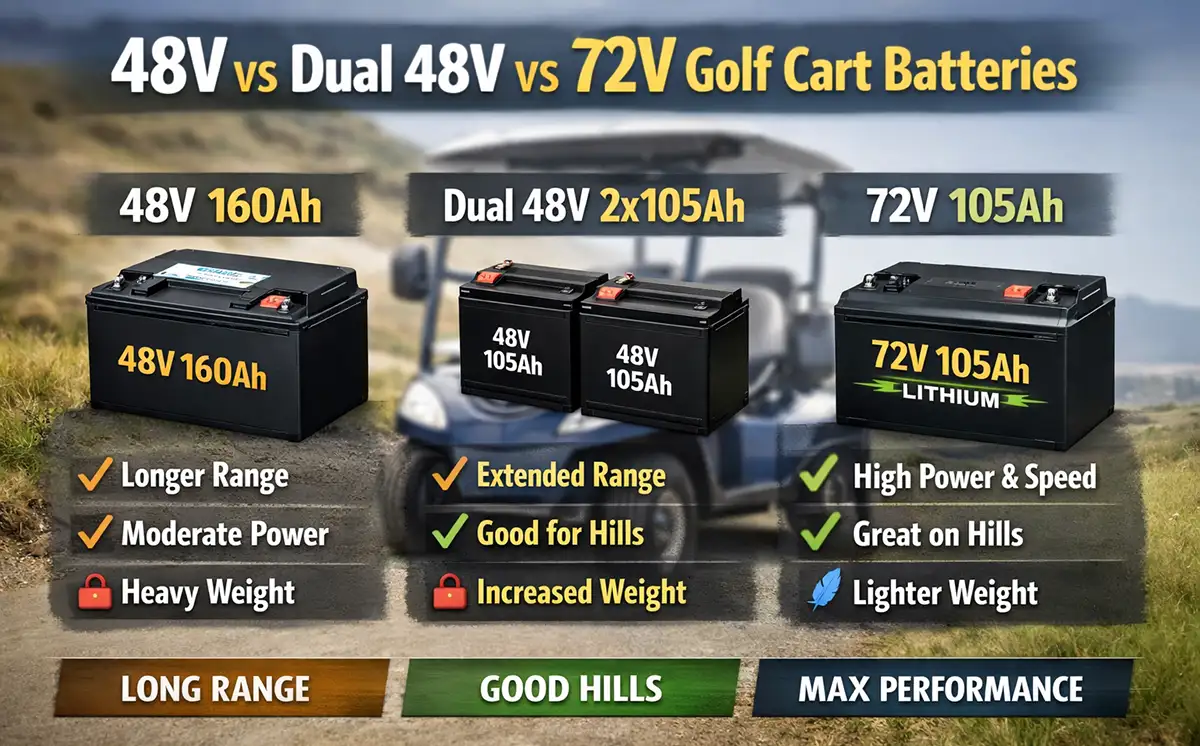
1. 48V High Amp-Hour Battery (e.g., 160Ah)
This option focuses on increasing capacity rather than voltage.
Pros:
- Longer runtime
- No major system upgrades required
- Lower upfront complexity
Cons:
- Limited power increase
- Still struggles on steep hills
- Heavier battery weight
2. Dual 48V Battery Setup (Parallel Configuration)
Running two batteries in parallel increases capacity.
Pros:
- Extended range
- Redundancy
- Moderate performance improvement
Cons:
- Increased weight
- More wiring complexity
- Still limited by 48V ceiling
3. 72V Battery System (e.g., 105Ah)
This is a full upgrade in voltage and performance.
Pros:
- Strong torque and acceleration
- Excellent for hills and heavy loads
- More efficient power delivery
Cons:
- Requires motor upgrade
- Higher initial setup cost
- Additional components needed
Performance Comparison Table
| Feature | 48V 160Ah | Dual 48V (2x10⁵Ah) | 72V 105Ah |
|---|---|---|---|
| Power Output | Moderate | Moderate | High |
| Hill Climbing | Fair | Good | Excellent |
| Range | High | Very High | Moderate-High |
| Speed | Standard | Slightly Higher | High |
| System Complexity | Low | Medium | High |
Do You Need to Upgrade Other Components?
Motor Upgrade
A 72V system requires a compatible motor. Running 72V through a 48V motor can cause overheating or failure.
Controller Compatibility
If you already have a high-performance controller, you’re ahead of the game—but it must support 72V operation.
Charger Replacement
You’ll need a charger designed specifically for a 72V battery system.
Wiring & Safety
Higher voltage means stricter requirements for wiring quality and insulation.
Is 72V Worth It for Hilly Terrain?
Absolutely. If you regularly drive in hilly areas or carry multiple passengers, a 72V system provides:
- Consistent power uphill
- Reduced slowdown under load
- Better overall driving experience
In contrast, even high-capacity 48V setups may struggle when pushed to their limits.
Cost Breakdown: 48V vs 72V Upgrade
48V Upgrade Costs
- Battery replacement: Lower cost
- Minimal additional components
- Easier installation
72V Upgrade Costs
- Battery: Moderate cost
- Motor upgrade: Required
- Charger + wiring: Additional cost
While the upfront investment is higher, many users find that the performance benefits justify the expense—especially in demanding conditions.
Weight Considerations
Heavier batteries can reduce efficiency and speed. Here’s how they compare:
- 48V high Ah batteries: Heaviest
- Dual battery setups: Very heavy
- 72V lithium systems: Typically lighter
Switching to a 72V lithium battery often offsets the added voltage with reduced overall weight.
Real-World Use Cases
Best for 48V Systems
- Flat neighborhoods
- Light passenger loads
- Casual driving
Best for 72V Systems
- Hilly terrain
- Heavy loads (passengers + gear)
- Performance-focused users
Common Mistakes to Avoid
- Choosing capacity over voltage when power is the real issue
- Using incompatible motors
- Skipping controller checks
- Underestimating wiring requirements
For any hesitation, it’s always recommended to contact a golf cart dealer who offers professional golf cart battery services and conversions.
FAQs About Upgrading from 48V to 72V Golf Cart Battery
Not if properly installed with compatible components. Incorrect setups can cause damage.
Yes, generally. A 72V system can achieve higher speeds with the right configuration.
Yes, a 72V battery requires a matching charger.
Only if it supports 72V. Otherwise, it must be replaced.
It depends. Amp-hours increase range, while voltage increases power and performance.
It varies, but many users see noticeable improvements in both speed and acceleration.
Conclusion: Which Setup Should You Choose?
Choosing between a 48V and 72V system ultimately depends on how you use your golf cart.
If you prioritize longer range and simplicity, a high-capacity 48V setup might be enough. But if you need power, torque, and reliable performance on hills or with heavy loads, upgrading from 48V to 72V golf cart battery systems is the smarter move.
It’s not just an upgrade—it’s a transformation in how your cart performs.