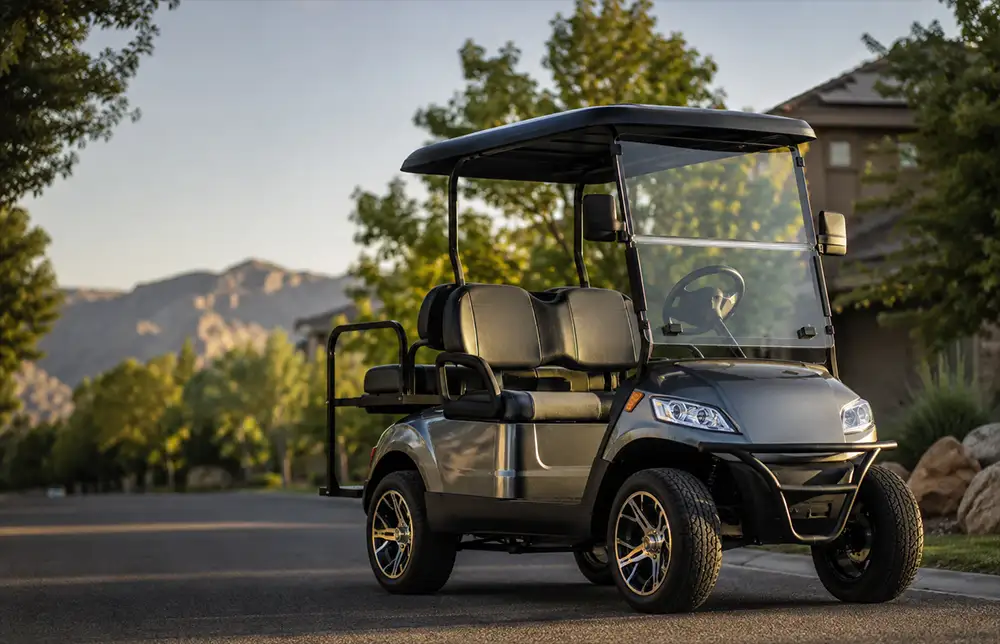
People get this wrong constantly. They buy a fast golf cart, assume it is street legal because it goes 25 mph, and then find out at the worst possible moment that speed alone has nothing to do with it. A golf cart is not a Low Speed Vehicle just because it drives quickly. Colorado has a specific checklist, and every single item on that checklist has to be satisfied before you can legally take a cart onto a public road.
This guide walks you through exactly what Colorado requires, why each requirement exists, and what it means for anyone shopping for a cart they actually want to drive in their neighborhood. If you already know the law and are ready to browse compliant models, you can go directly to our street legal golf carts for sale in Colorado. If you want to understand what you are buying first, keep reading.
Requirement 1: The Cart Must Qualify as a Low Speed Vehicle Under FMVSS 500
Federal Motor Vehicle Safety Standard 500 is the legal definition that separates a golf cart from a street-legal vehicle. To meet FMVSS 500, a cart must be capable of a top speed between 20 and 25 mph on a paved level surface. A cart that tops out at 15 mph does not qualify, even if it is otherwise well-equipped. A cart capable of exceeding 25 mph falls into a different vehicle classification entirely and faces a different set of federal standards.
This is why so many older Club Cars, E-Z-GOs, and Yamaha golf carts cannot be made street legal without significant modification. Their motors were never designed to hit the 20 to 25 mph range reliably under load. You can learn more about the full technical picture in our guide on what makes a golf cart street legal in Colorado.
Requirement 2: A Vehicle Identification Number
A street-legal Low Speed Vehicle must carry a VIN just like any car or truck. This is not something you add to an existing cart after the fact. The VIN is assigned at the manufacturer level when the vehicle is built to FMVSS 500 standards. If a cart does not come with a VIN from the factory, it cannot be registered as a Low Speed Vehicle with the Colorado DMV, which means it cannot legally be driven on public roads no matter what other equipment you add to it.
Every street-legal model we carry at 303 Cart Barn comes with a manufacturer-assigned VIN and full documentation for Colorado registration.
Requirement 3: DOT-Approved Lighting
Colorado requires headlights, taillights, turn signals, stop lamps, and reflex reflectors that meet Department of Transportation standards. The headlights must be capable of illuminating the road ahead at night, and the turn signals must be amber. Many golf carts sold for course use have LED lighting packages that look great but do not meet DOT certification because they were never tested or approved for on-road use.
When you buy a factory-built LSV like the Epic E40FX, the lighting comes DOT-approved from the manufacturer. When you try to retrofit an older cart, getting the lighting certified is often the single most expensive and complicated step in the process.
Requirement 4: Seat Belts for Every Seating Position
Every seating position on a street-legal golf cart in Colorado must have a functioning seat belt. This catches people off guard because golf carts historically did not have seat belts, and many aftermarket options do not meet the federal anchor strength requirements. Again, this is a standard that is built into LSV-certified models at the factory rather than something bolted on afterward.
Requirement 5: A Windshield
A proper windshield is required, not an optional add-on. The windshield must be made of safety glass or an approved polycarbonate material. Fabric enclosures and mesh windscreens that are common on golf course carts do not satisfy this requirement. Many buyers who try to convert a basic cart to street-legal status discover that installing a compliant windshield requires frame modifications that quickly become cost-prohibitive.
Requirement 6: Speedometer, Parking Brake, and Rear View Mirrors
A functioning speedometer, a parking brake, and at minimum one rear view mirror are all required under FMVSS 500. These are the items most often overlooked in DIY street-legal conversion projects. The speedometer must be accurate within a reasonable tolerance, and the parking brake must be capable of holding the vehicle stationary on a grade. A single exterior mirror on the driver’s side meets the baseline requirement, though two mirrors are common on most factory-built LSVs.
Requirement 7: Colorado DMV Registration and Liability Insurance
Once a cart meets all six physical requirements above, it still needs to be registered with the Colorado Division of Motor Vehicles as a Low Speed Vehicle. Registration requires a title, proof of insurance, and the standard DMV fees. Liability insurance at Colorado’s minimum coverage levels is mandatory, the same as any registered motor vehicle in the state.
After registration, the vehicle receives a license plate and is treated as a motor vehicle for legal purposes. That means a valid driver’s license is required to operate it on public roads. For a full breakdown of where you can and cannot drive once registered, our Colorado golf cart laws guide covers speed limits, road access, and intersection crossing rules in detail. If you are in Denver, Boulder, Fort Collins, or Colorado Springs specifically, the city-by-city golf cart law breakdown is worth reviewing since local ordinances can be more restrictive than state law.
The Fastest Way to Get a Street Legal Cart in Colorado
The most reliable path to a street-legal golf cart in Colorado is buying one that was built to FMVSS 500 standards at the factory. Every item on the checklist above is addressed by the manufacturer, the VIN is already assigned, and 303 Cart Barn handles the documentation that makes registration straightforward.
Our street legal golf cart inventory includes models from Epic, Evolution, Icon, and Sierra. All of them are fully compliant, properly documented, and ready to register. If you have questions about which model fits your neighborhood, your budget, or your use case, call us at 303-440-8400. We also offer flexible financing so you can get into a compliant cart without paying for it all at once.
Frequently Asked Questions
Can I make any golf cart street legal in Colorado?
Not every golf cart can be converted. To qualify as a street-legal Low Speed Vehicle, the cart must reach between 20 and 25 mph and meet all FMVSS 500 safety standards including a VIN, DOT lighting, seat belts, a windshield, and a speedometer. Many older carts cannot satisfy these requirements without major and expensive modifications.
Do I need insurance for a street legal golf cart in Colorado?
Yes. If your golf cart is registered as a Low Speed Vehicle in Colorado, liability insurance is required just like any other registered motor vehicle. Coverage minimums follow Colorado’s standard auto insurance requirements.
What roads can I drive a street legal golf cart on in Colorado?
Colorado Low Speed Vehicles are restricted to roads with posted speed limits of 35 mph or lower. They cannot be driven on highways or interstates, but they can cross higher-speed roads at designated intersections.
Do I need a driver’s license to drive a street legal golf cart in Colorado?
Yes. Because a street-legal golf cart is registered as a Low Speed Vehicle with the DMV, a valid driver’s license is required to operate it on public roads.
What is the difference between a golf cart and a Low Speed Vehicle in Colorado?
A golf cart is a utility vehicle built for course use and is not legal on public roads. A Low Speed Vehicle meets federal FMVSS 500 standards, carries a VIN, can be registered with the Colorado DMV, and is legal on roads with speed limits of 35 mph or lower.
Where can I buy a street legal golf cart in Colorado?
303 Cart Barn in Littleton carries a full inventory of street-legal Low Speed Vehicles from Epic, Evolution, Icon, and Sierra. All street-legal models come with a VIN and full DOT compliance. Financing is available and delivery covers the entire Denver metro area.