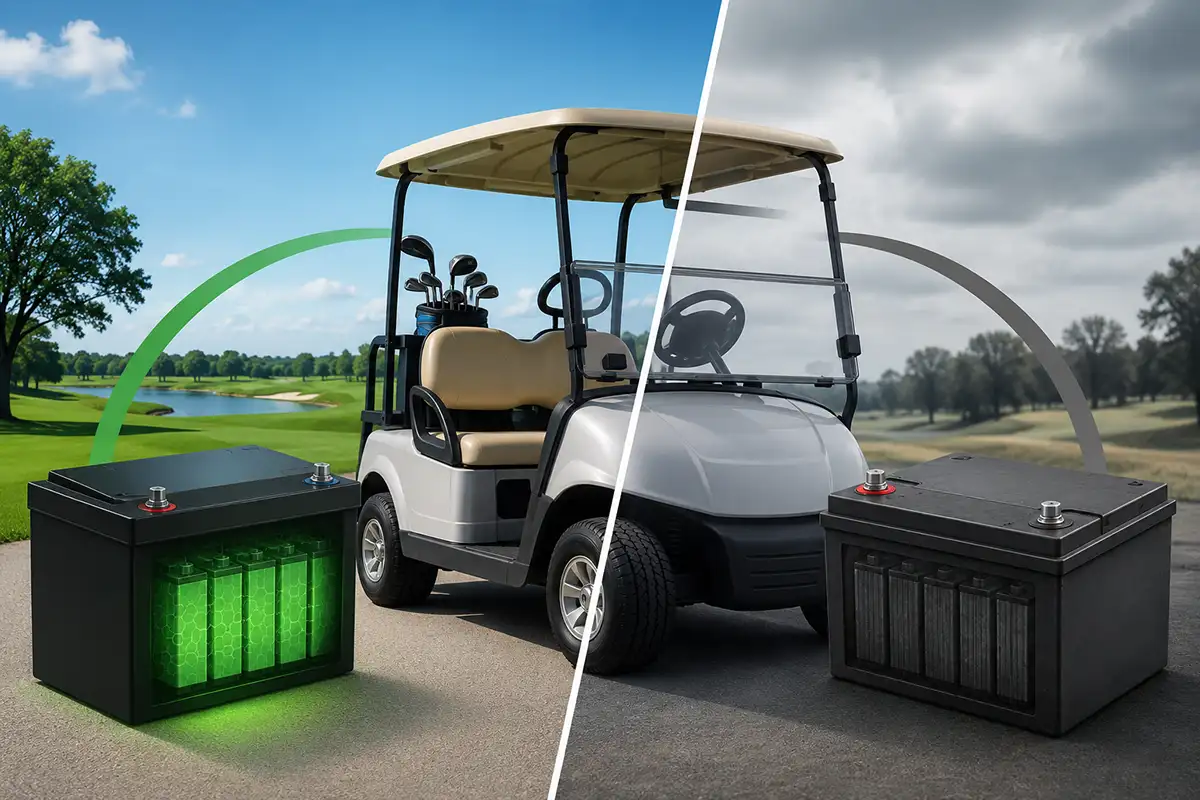
Quick answer: LiFePO4 (lithium iron phosphate) and standard lithium ion (NMC) are two different battery chemistries. For golf carts, LiFePO4 is the better long-term choice: it lasts 8 to 12 years, handles Colorado cold and altitude better, and is inherently safer. Standard lithium NMC packs are lighter and more energy-dense but degrade faster and carry more thermal risk. 303 Cart Barn carries Sierra LiFePO4 batteries and installs them at our Littleton, Colorado location.
When people say they want to upgrade their golf cart to lithium, they often do not realize there are two very different things that sentence could mean. LiFePO4 and standard lithium ion batteries are both lithium-based, but they use different chemistry, age differently, handle temperature differently, and cost differently over their lifetime. If you are buying a new cart or upgrading an existing one in Colorado, understanding the difference could save you thousands of dollars and years of frustration.
What Is the Difference Between LiFePO4 and Standard Lithium?
All lithium batteries share the same basic concept: lithium ions move between a cathode and an anode during charge and discharge. What separates them is the cathode material, and that material determines almost everything about how the battery behaves in real use.
LiFePO4 (Lithium Iron Phosphate)
LiFePO4 uses iron phosphate as the cathode material. Iron phosphate is one of the most chemically stable cathode materials available, which is why LiFePO4 batteries are known for their safety, longevity, and resistance to heat. The tradeoff is slightly lower energy density compared to NMC — a LiFePO4 pack is a bit heavier per kilowatt-hour of storage than its NMC equivalent.
Standard Lithium Ion (NMC / NCA)
Standard lithium ion batteries most commonly use nickel manganese cobalt (NMC) or nickel cobalt aluminum (NCA) cathode chemistry. These packs have higher energy density — more power in less weight and volume — which is why they dominate consumer electronics and some EV applications. The cost is reduced thermal stability. NMC chemistry can enter thermal runaway under overcharge, physical damage, or extreme heat, which is why so many consumer batteries have complex cooling systems.
For a golf cart, which sits in a garage, gets charged overnight, and operates in varying weather, the weight savings of NMC rarely justify the reduced safety margin and shorter lifespan.
Side by Side: LiFePO4 vs Standard Lithium vs Lead Acid
| Feature | LiFePO4 | Standard Lithium (NMC) | Lead Acid |
|---|---|---|---|
| Cycle life | 2,000 to 3,500 cycles | 500 to 1,000 cycles | 300 to 500 cycles |
| Typical lifespan | 8 to 12 years | 3 to 5 years | 2 to 4 years |
| Thermal safety | Excellent — no thermal runaway risk | Moderate — runaway risk under stress | Good — but off-gases hydrogen |
| Energy density | Good | Better | Poor |
| Weight | Light (50 to 70% less than lead acid) | Lightest | Heaviest |
| Discharge curve | Very flat — consistent speed all ride | Flat — slight taper at end | Steep — slows as battery drains |
| Cold weather performance | Good with BMS protection | Moderate | Poor — significant capacity loss |
| Maintenance | None | None | Regular watering and equalization |
| Upfront cost | $1,200 to $2,800 | $900 to $2,200 | $400 to $800 |
How LiFePO4 Performs at Colorado Altitude and in Cold Weather
This is the question most national battery guides skip entirely, and it is the most relevant one for Colorado golf cart owners.
Altitude
Battery chemistry itself is not meaningfully affected by altitude — the electrochemical reactions inside the cell do not depend on atmospheric pressure. What altitude does affect is the electric motor, which works slightly harder to move the cart at elevation due to reduced aerodynamic efficiency and, if you are on terrain, increased load on climbs. A LiFePO4 battery’s flat discharge curve means it delivers consistent voltage even as the motor draws harder, which keeps your speed more stable than a lead acid pack that sags under load.
Cold winters
Colorado winters are the real test. Lead acid batteries can lose 30 to 50 percent of their capacity at freezing temperatures. Standard NMC lithium holds up better but still loses meaningful capacity in sustained cold. LiFePO4 handles cold better than both, though it shares one important limitation with all lithium chemistries: charging below freezing can cause lithium plating on the anode, which permanently damages the cell.
The solution is a battery management system (BMS) with low-temperature charge cutoff, which stops charging when the cell temperature drops below 32°F. Quality LiFePO4 packs designed for outdoor vehicle use — including the Sierra lithium batteries we carry — include this protection as standard. If you are comparing battery options, verifying BMS cold-weather protection should be a non-negotiable requirement for any Colorado buyer.
The Real Cost Comparison Over Time
Upfront price comparisons favor lead acid, but they tell the wrong story. Here is what ten years of ownership actually looks like for a typical Colorado golf cart owner:
Lead acid over 10 years
A lead acid pack costs $400 to $800 and lasts 2 to 4 years with proper maintenance. Over 10 years you will replace it two to three times. Add in the time cost of monthly watering, annual equalization charges, and the performance degradation in Colorado winters, and the total cost of lead acid ownership over a decade runs $1,200 to $2,400 in battery costs alone — plus maintenance time.
LiFePO4 over 10 years
A LiFePO4 pack costs $1,200 to $2,800 upfront and lasts 8 to 12 years. In most cases you buy it once and it outlasts your ownership of the cart. Zero maintenance, consistent performance, and no degradation surprises in winter. The higher upfront cost is typically recovered within four to six years through avoided replacements and eliminated maintenance.
Standard lithium (NMC) over 10 years
NMC packs fall between the two — lower upfront cost than LiFePO4 but shorter lifespan, meaning you may replace the pack once in a decade. The total cost of ownership lands close to LiFePO4, without the safety and longevity advantages.
Which Carts at 303 Cart Barn Come Lithium Ready?
Several brands we carry are built with lithium battery integration from the factory rather than treating it as an add-on:
- Sierra golf carts — Sierra builds their entire platform around LiFePO4. The AX series carts come with an integrated Sierra lithium pack and a purpose-built BMS. This is not a retrofit; the cart is designed around lithium from the ground up, which means the charging profile, controller programming, and display are all optimized for the chemistry. Read our Sierra golf cart reviews and model comparisons.
- Epic golf carts — Epic’s E40FX and E60FX are lithium-compatible from the factory and pair well with aftermarket LiFePO4 upgrades.
- Icon golf carts — Several Icon models support lithium upgrades. We recommend verifying the BMS compatibility before installation on older Icon platforms.
- Evolution D5 and D-Max series — Lithium upgrades are a popular pairing with Evolution’s performance platform, particularly on lifted D-Max builds where the reduced weight of lithium over lead acid meaningfully improves handling.
Should You Upgrade Your Existing Cart to LiFePO4?
If your current lead acid pack is due for replacement, upgrading to LiFePO4 at that moment makes strong financial sense. You avoid the replacement cost of lead acid, gain 8 to 12 years of reliable service, and immediately notice the performance difference — faster acceleration, consistent speed through the full charge, and no winter performance surprises.
If your lead acid pack still has useful life remaining, the calculus is less clear. The upgrade cost may not pay back before your lead acid pack needs replacing. In that case, our team can help you assess remaining battery health and time the upgrade to make the most financial sense.
See our 48V to 72V battery upgrade guide if you are also considering a voltage upgrade alongside the chemistry switch — the two decisions often go hand in hand.
Get a LiFePO4 Battery Upgrade at 303 Cart Barn
We carry Sierra LiFePO4 batteries and install them on most major golf cart platforms at our Littleton, Colorado shop. We also carry new golf carts with lithium built in from the factory. Financing available on new cart purchases.
Frequently Asked Questions: LiFePO4 vs Lithium Golf Cart Batteries
What is a LiFePO4 golf cart battery?
LiFePO4 stands for lithium iron phosphate — a specific lithium battery chemistry that uses an iron phosphate cathode instead of nickel or cobalt. It is more thermally stable, safer, and longer-lasting than standard lithium ion, with a typical cycle life of 2,000 to 3,500 full charge cycles and an 8 to 12 year service life in golf cart applications.
Is LiFePO4 better than standard lithium for a golf cart?
For most golf cart owners, yes. LiFePO4 lasts two to three times longer than standard NMC lithium, does not carry thermal runaway risk, delivers a flatter discharge curve for consistent speed throughout the ride, and handles Colorado cold better. Standard lithium NMC is lighter and more energy dense, which matters in weight-critical applications — but not significantly so for a golf cart.
How long does a LiFePO4 golf cart battery last?
A quality LiFePO4 golf cart battery lasts 8 to 12 years under regular use, based on a 2,000 to 3,500 cycle life. This is two to three times longer than standard lithium and three to five times longer than lead acid. Lifespan depends on depth of discharge, storage habits, and whether the BMS is properly matched to the pack.
How does LiFePO4 perform at Colorado altitude and in cold weather?
LiFePO4 performs better than standard lithium and significantly better than lead acid in Colorado conditions. Altitude does not affect the battery chemistry itself. In cold weather, LiFePO4 retains more capacity than other chemistries, though charging below freezing requires a BMS with low-temperature cutoff protection — standard on quality packs like Sierra batteries carried by 303 Cart Barn.
How much does a LiFePO4 golf cart battery cost?
A LiFePO4 golf cart battery pack costs $1,200 to $2,800 depending on voltage and capacity. While the upfront cost is higher than lead acid at $400 to $800, the total cost of ownership over 8 to 12 years is lower when you factor in avoided replacements, zero maintenance, and better performance. 303 Cart Barn carries Sierra lithium batteries and provides professional installation in Littleton, Colorado.