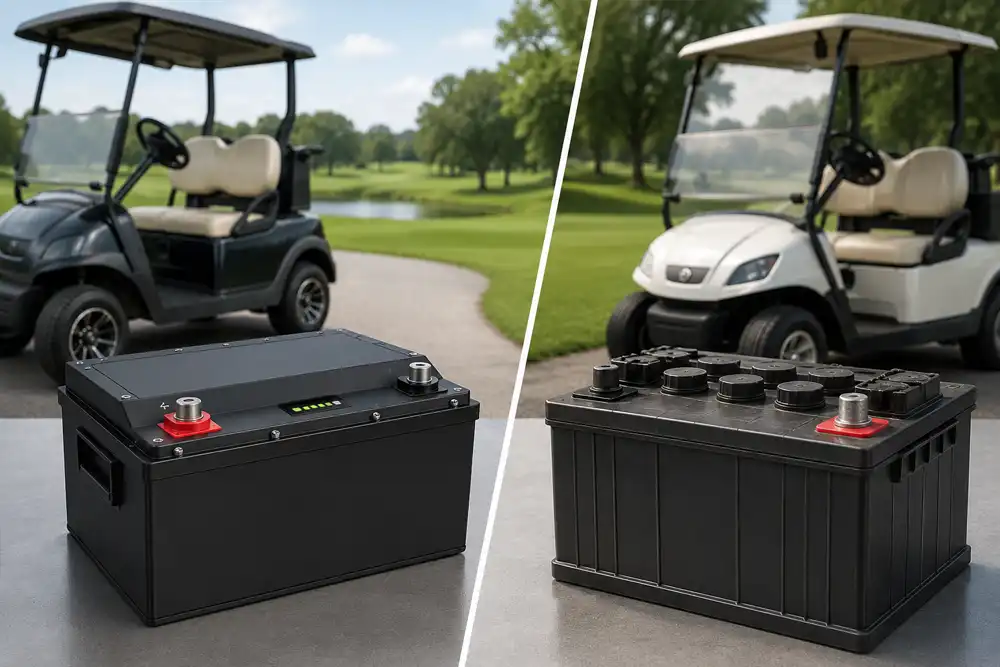
Battery type affects your golf cart more than almost any other spec. It changes your range, your charging routine, your maintenance schedule, and how much the cart is worth when you go to sell it. Here’s what actually separates lithium from lead-acid.
Upfront Cost
Lead-acid batteries, often listed as AGM batteries, cost less upfront. Many entry-level carts, like the Epic E20, ship standard with AGM batteries to keep the base price lower. Lithium batteries cost more to start, but the gap has narrowed as lithium has become more common across the industry, including as standard equipment on models like the Epic E40FX and the full Tara EV lineup.
Range and Performance
Lithium batteries hold their voltage more consistently as they discharge, which means steadier power output, even late in a charge cycle or under load on hills. Lead-acid batteries can lose power output as they drain, especially with multiple passengers or on inclines. If you drive hilly terrain regularly, lithium’s consistent output is a real, noticeable difference, not just a spec sheet number.
Charging Time and Convenience
Lithium batteries generally charge faster than lead-acid and can handle partial charges without damaging the battery’s long-term lifespan. Lead-acid batteries typically need a full charge cycle to stay healthy, and repeated partial charging can shorten their usable life over time.
Maintenance
This is where lithium has the clearest advantage. AGM lead-acid batteries are maintenance-free compared to older flooded lead-acid batteries, but they still degrade faster under heat and heavy use, which matters in Colorado’s summer swings. Lithium batteries need essentially no maintenance and hold up better across temperature extremes, which is part of why we discussed battery condition as a major factor in our new vs used golf cart guide.
Lifespan and Long-Term Value
Lithium batteries typically last significantly longer than lead-acid before needing replacement, often several times as many charge cycles. That longer lifespan is a major reason lithium-equipped carts, like Icon’s i40L or Dach’s core lineup, tend to hold resale value better than comparable lead-acid models. If you’re buying used, ask specifically which battery type is installed, not just the brand or model year, since it directly affects what the cart is worth.
Which Should You Buy?
If upfront cost matters most and you don’t mind periodic maintenance, a lead-acid or AGM battery is a reasonable, lower-cost option. If you want the longest lifespan, the least maintenance, and the most consistent power, lithium is worth the higher initial cost, especially if you plan to keep the cart for many years. Already own a cart with an aging lead-acid battery? Our battery upgrade service can convert it to lithium.
Frequently Asked Questions
How much longer do lithium batteries last than lead-acid?
Lithium batteries typically last several times longer than lead-acid batteries in charge cycle life, though actual lifespan depends on usage and care.
Can I upgrade my current cart from lead-acid to lithium?
Yes, in most cases. 303 Cart Barn offers battery upgrade service to convert eligible carts to lithium.
Do lithium batteries perform better in cold weather?
Lithium batteries generally hold up better across temperature extremes than lead-acid, which matters for Colorado’s seasonal swings.
Is a lithium battery worth the extra cost?
For most owners who keep a cart for several years, yes. The longer lifespan and lower maintenance often offset the higher upfront price over time.
Which 303 Cart Barn models come with lithium standard?
Tara EV’s full lineup, Dach’s core models, and select Icon EV and Epic trims like the i40L and E40FX come standard with lithium. Ask our sales team about the exact configuration on any specific unit.