

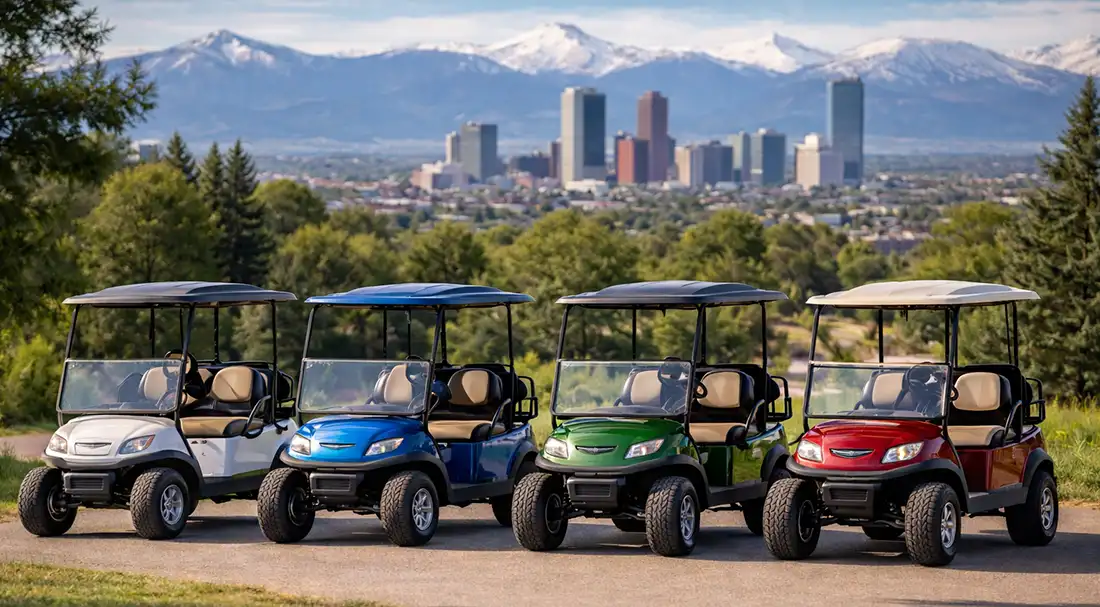
Golf carts and similar low-speed vehicles (LSVs) are becoming increasingly popular around Colorado — not just on golf courses, but in neighborhoods, communities, and on local streets. However, Colorado doesn’t have a single statewide rule for golf carts on public roads: instead, it’s up to each city or town to decide where and how they’re allowed to be used.
In this guide, we’ll break down the most important laws and common‑sense rules for golf cart operation in four key Colorado cities: Denver, Boulder, Fort Collins, and Colorado Springs — with a friendly, informal take on what you actually need to know (beyond the legal jargon). We’ll also cover safety basics, equipment tips, and why this matters if you’re thinking about getting a street‑legal ride.
Quick Legal Background: Colorado & Golf Carts
Before jumping into city‑by‑city rules, it’s helpful to understand how things work in Colorado generally:
- Golf carts are not automatically street‑legal in Colorado. They must either be upgraded to meet Low‑Speed Vehicle (LSV) standards (with safety lights, seat belts, turn signals, etc.) and registered like a vehicle — or they must be allowed by local ordinance in a specific city or town.
- LSVs that do meet state standards can usually operate on streets with speed limits up to 35 mph, but must be registered, insured, and driven by a licensed driver.
- Standard golf carts that don’t meet an LSV’s safety requirements are generally restricted from public road use unless your city specifically says they’re allowed.
Now, let’s break it down by city.
Denver Golf Carts: Tight Rules, Rare Street Access
When people see Denver golf carts cruising around, it’s often in neighborhoods or on private pathways — not because golf carts are broadly free to roam: Denver generally restricts golf cart operation on public roads unless you jump through specific hoops.
Here’s the deal in Denver:
- Ordinary golf carts don’t have unrestricted street access. You usually need a special permit and must comply with traffic laws when you do operate one on city roads.
- There are specific equipment requirements and liability conditions attached to permit approval — think safety lights, slow‑moving emblems, and proof of insurance.
- Even with a permit, carts can’t go everywhere: sidewalks, bike paths, parks, and high‑speed roads are off‑limits.
So if you’re in Denver and want to get around town on a golf cart more often than just across your yard or at a golf course, make sure you know what permits, plates, and safety gear are required before going out — especially to avoid fines or liability headaches.
Boulder Golf Carts: Suburban Friendly With Limits
In Boulder, golf carts are a bit more accepted in residential settings — especially in neighborhoods where people use them for short errands or connecting with local parks and community centers.
However:
- Boulder generally requires an LSV conversion — meaning your cart needs lights, turn signals, mirrors, and other approved safety gear — if you want to use it on public streets beyond golf course or private community roads.
- Bike paths and hiking trails are off‑limits for any motorized cart, including golf carts/LSVs.
- Standard golf carts without upgrades are usually limited to private property or designated community routes.
If your cart is fully equipped and registered as an LSV, you’ll find Boulder is among the cities on the Front Range that allow street‑legal cart usage — just keep it slow (35 mph roads max) and respect no‑motor zones.
Check out local options for delivery and service at Boulder golf carts.
Fort Collins Golf Carts: Community‑Aware, Safety‑First
Fort Collins takes a thoughtful approach:
- While the city doesn’t have as specific a golf cart ordinance posted online as some others, statewide and municipal rules around LSVs and street usage still apply. This means that your cart must be equipped and registered for street use to be legal beyond private property.
- Fort Collins’ transportation policies focus on mixing vehicles safely. Carts need to be treated like other motorized vehicles when on the road — and expect restrictions.
For folks in NoCo wanting to explore golf cart options that meet those standards, Fort Collins golf carts is a go‑to for sales and support.
Colorado Springs Golf Carts: Road Access With Common Sense
In Colorado Springs, the pattern tracks closely with broader Colorado LSV laws:
- Carts that are upgraded to LSV standards (headlights, mirrors, brakes, etc.) and registered/insured can be driven on streets with speed limits up to about 35 mph.
- Regular golf carts without that level of equipment are mostly restricted to private or golf course property unless the city has a specific ordinance allowing broader use.
Colorado Springs also tends to enforce parking and traffic laws strictly. Make sure you’re aware of permit and registration requirements before cruising around the Springs in your cart. You’ll find local options and help at Colorado Springs golf carts.
Tips for All Colorado Golf Cart Owners
No matter where you’re cruising:
- Know your cart’s classification. Is it a regular golf cart? A street‑ready cart? Or a fully registered LSV? Where you can drive it depends on that.
- Safety gear isn’t just smart — often required. Lights, seat belts, mirrors, and slow‑moving vehicle signs are basics for public use.
- Check local ordinances early. Just because your neighborhood seems golf‑cart friendly doesn’t mean the city has adopted a code that allows street use — and enforcement varies.
- Insurance and licensing matter. Even if you’re on private property, liability coverage and a licensed driver are typically required for street use.
FAQs About Golf Cart Laws in Colorado
Only if they meet LSV safety and registration standards, or if a local ordinance specifically allows golf cart use on public streets.
Yes — especially if it’s classified as an LSV and you intend to use it on streets.
Only if it has proper lighting and meets LSV equipment requirements. Otherwise, many local rules restrict nighttime use.
LSVs can typically travel on roads with speed limits up to ~35 mph; regular carts are often limited or require special permission.
No — sidewalks, bike paths, and pedestrian trails are generally off‑limits unless specifically allowed.
Yes — if you’re operating on public streets, golf cart insurance is a must (and often a requirement for permits/registration).
Related Legal Articles:
- What Makes a Golf Cart Street Legal in Colorado?
- Golf Cart Laws in Colorado: What You Need to Know
- Golf Cart Age Requirements | Legal Driving Age Guide
- Do You Need a License to Drive a Golf Cart?
Legal Disclaimer: This article is for informational purposes only. Local and state laws vary, and regulations regarding golf cart and low-speed vehicle use change over time. Always research and confirm the current laws in your community before operating a golf cart on public streets.


